
7 Steps to Choosing a Dubai Interior Designer
7 Steps to Choosing a Dubai Interior Designer
- admin2
- 0 comments
- 13 views

Choosing an Interior Designer in Dubai requires balancing personal style with professional expertise.
Quick Navigation
Key Takeaways
- When choosing an interior designer in Dubai, define your project scope, style, and budget before approaching any firm.
- Always verify a designer’s Dubai Municipality licence before committing to any agreement.
- A great portfolio shows versatility; a one-note portfolio suggests a firm that will impose their style on you rather than interpret yours.
- Chemistry matters as much as credentials — you will spend months collaborating closely with this team.
- Read the contract carefully; the scope of work, payment structure, and defect liability period protect you if issues arise.
Choosing an interior designer in Dubai is your top priority in a city with hundreds of firms operating across boutique studios and large design-and-build companies. Finding the right partner whose skills, process, and communication style align with your project ensures a successful transformation of your space.
These seven steps will give you a structured approach to making that decision with confidence.
1 Define Your Project Scope and Style
Before you approach a single firm, spend time getting clear on what you actually need. The more specific your brief, the better every conversation will be — and the more accurately firms can respond with relevant portfolios and realistic estimates.
Residential, commercial, or hospitality?
Interior design expertise is not interchangeable across sectors. A firm renowned for luxury villas may have no experience designing a restaurant or a retail space, and vice versa. Identify your project category first. Within residential, clarify whether it is an apartment, a villa, or a penthouse — the challenges and typical scopes differ considerably. Within commercial, distinguish between office design, retail design, and hospitality (F&B, hotels, wellness).
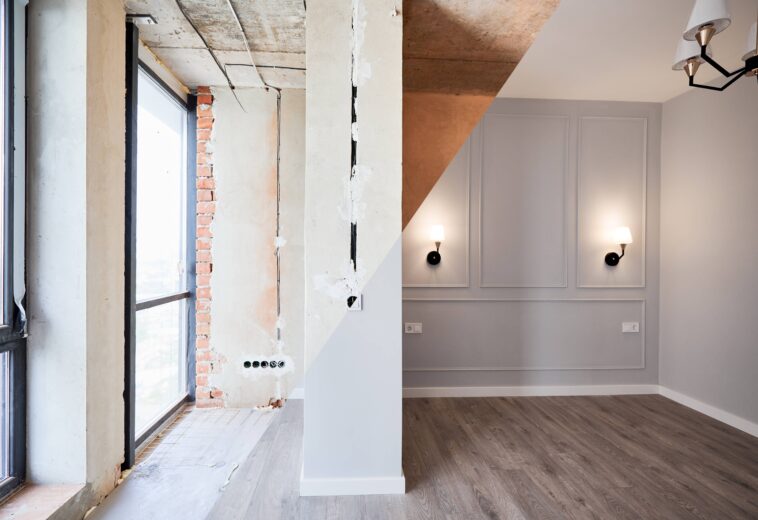
New build vs. renovation
A newly handed-over property gives a designer maximum freedom — they are working with a blank canvas and only the architecture is fixed. A renovation introduces additional variables: existing finishes that may be retained or removed, structural elements that cannot be changed without approvals, and potentially occupied spaces that need to remain partially functional during works. Be honest with yourself about which situation applies and confirm that your shortlisted firms have experience with that specific scenario. Check our portfolio to see how we handle different build scenarios.
2. Set a Realistic Budget When Choosing an Interior Designer in Dubai

Choosing an interior designer in Dubai involves setting a budget early to keep your vision realistic.
One of the most common mistakes clients make is approaching designers without a clear budget in mind. This leads to wasted time on both sides and — worse — sets expectations that may be impossible to meet.
UAE industry pricing benchmarks (2026)
Interior design and fit-out in Dubai in 2026 typically costs between AED 150 and AED 1,200+ per square foot for the combined design-and-execution scope. Licensed full-service designers charge AED 175–550 per sq ft; design-only fees run AED 100–350 per sq m or 8–15% of total project value. For a 3,000 sq ft villa at a mid-range finish level, plan AED 900,000–1.5 million all-in. At a luxury specification — imported stone, custom furniture, smart home integration — budget AED 2.0–3.0 million. Commercial Cat B office fit-out in Business Bay or DIFC runs AED 280–550 per sq ft mid-spec. All fees are subject to 5% UAE VAT.
What is and isn’t included in design fees
Clarify from the outset whether a quoted design fee covers: space planning, concept development, 3D visualisation, technical drawings, furniture specification, material schedules, and on-site supervision. Many firms quote design and fit-out separately. Others offer an integrated package. Neither model is inherently better, but you need to know which you are dealing with to compare quotes on a like-for-like basis.
3. Review Portfolios With a Critical Eye
What to look for beyond aesthetics
Most portfolio pages look appealing — beautiful photography is not evidence of design quality. Look instead for evidence of problem-solving. How did the designer handle an awkward floor plan? How do they manage the transition between spaces? Are the spaces functional as well as beautiful? Does the lighting work throughout the day, not just in a perfectly staged shoot? The best portfolios reveal decisions, not just outcomes.
Versatility vs. signature style
Some designers have a strong, recognisable signature — their projects all share a consistent aesthetic DNA. This is appealing if that style matches yours, but it is a warning sign if you are looking for something different. Versatile firms demonstrate the ability to execute contemporary minimalism, Arabic-influenced luxury, and classical European schemes with equal confidence. Ask directly: “What would you do differently for a client who wanted something outside your typical style?” You can explore our design services for a range of styles.
4. Verify Credentials and Licensing

Verification is a key step when choosing an interior designer in Dubai.
Dubai Municipality licence check
In Dubai, any firm conducting fit-out works must hold an active trade licence and, for structural or MEP works, an approved contractor registration with Dubai Municipality. Consequently, you should ask for the firm’s licence number and trade name. You can then verify it through the Dubai DED (Department of Economy and Tourism) business search portal. Specifically, if a firm is hesitant to provide this information, treat that as a significant red flag. Working with unlicensed contractors exposes you to legal liability and leaves you with no recourse if work is substandard.
Professional memberships and awards
While not mandatory, membership in professional bodies such as the International Interior Design Association (IIDA) or the American Society of Interior Designers (ASID) indicates that the firm engages with professional standards and continuing education. Regional and international award recognition — such as the Commercial Interior Design Awards or the International Property Awards — provides independent validation of quality. Neither is a guarantee, but both are positive indicators.
5. Check Reviews and Ask for References
What to ask past clients
Online reviews give you a general picture, but speaking directly with a previous client is far more informative. Ask a firm for two or three references from projects similar to yours in type and scale. When you speak with those clients, ask specifically: Did the project complete on time? Was the final cost close to the original estimate? How did the firm handle problems when they arose? Would you use them again? The answer to that last question is often the most telling.
Red flags to watch for
Watch for these warning signs: vague or evasive answers about timeline and cost; no willingness to provide references; portfolio images that cannot be verified as their own work; pressure to sign quickly or pay a large deposit before a contract is fully agreed; no clear point of contact once the project begins; resistance to putting agreed changes in writing.
6. Meet in Person and Assess Communication

Chemical and communication checks are vital when choosing an interior designer in Dubai.
Questions to ask in the first meeting
A first meeting is as much about how the designer listens as what they say. Come prepared with questions: Who specifically will be working on my project? How often will I receive progress updates? What is your typical process for handling on-site issues? How do you manage scope changes? A good designer will answer clearly and ask you equally sharp questions about your brief. Vague, noncommittal answers to direct questions are a reliable indicator of how communication will go once the project is underway.
Signs of a good working relationship
You will be working closely with this team for months. The designer should demonstrate genuine curiosity about how you live or work, not just what you want the space to look like. They should challenge ideas respectfully when they have a better solution, not simply agree with everything to secure the contract. And you should feel, after the meeting, that they understood your brief — not just heard it.
7. Review the Contract Thoroughly
Scope of work and exclusions
The contract must clearly define everything that is included in the agreed price: which rooms, which works, which FF&E items, which approvals. It must equally define what is excluded. Many disputes arise not from failure to deliver what was promised, but from different assumptions about what was promised in the first place. A well-written scope of work eliminates ambiguity on both sides.
Payment milestones and timelines
Standard payment structures in Dubai tie payments to milestones. Typically, this starts with an initial deposit at contract signing (20–30%). Furthermore, stage payments are tied to design approval, commencement of works, and practical completion.
Retention and Stage Payments
Finally, a retention amount (typically 5–10%) is held until the defect liability period expires. However, be cautious of any arrangement that requires more than 30–40% upfront before significant work has been delivered. A clearly defined project timeline with milestone dates should be attached to or incorporated within the contract.
FAQ
How many designers should I meet before choosing one?
Three to five is a practical number. Too few and you lack comparison; too many and the process becomes exhausting and the distinctions blur. Shortlist based on portfolio review first, then meet your top three and make your decision from there.
Should I choose a big firm or a small studio?
It depends on your project. Large firms offer more resources, more subcontractor relationships, and more capacity to manage complex multi-phase projects. Smaller studios often provide more direct access to senior designers and more personalised attention. Neither is universally better — match the firm’s size and capacity to your project’s scale and complexity.
Is it worth paying more for an internationally recognised firm?
Not automatically. International recognition matters for brand cachet on high-profile commercial or hospitality projects. For residential design, the most important factors are local knowledge, project management discipline, and chemistry with the design team — all of which can be found in excellent UAE-based firms without the international premium.
What happens if I change my mind mid-project?
Changes after on-site work begins cost more in both money and time. Most contracts include a change order process: you request a change, the firm prices it, and you approve before it is executed. Understanding this process — and the associated costs — before signing helps you make more deliberate decisions during the design phase rather than costly changes during construction.
Let’s Talk About Your Project
Sisterly Interior Decoration LLC offers a no-obligation consultation to walk through your brief, understand your vision, and give you a clear picture of what your project involves.