

Home Renovation Dubai 2026: Full Cost Guide & Timeline
Home Renovation Dubai 2026: Full Cost Guide & Timeline
- Chelsa
- 0 comments
- 10 views
Living Room Design Dubai: How to Create a Luxury Living Room That Feels Like Home
A Sisterly Interior Guide to Modern, Elegant Living Room Interiors in the UAE
Your living room is the heart of your home. It’s where morning coffee turns into quiet conversation, where guests are welcomed, and where a long day softens into a relaxed evening. For homeowners, villa owners, and businesses across Dubai and the wider UAE, getting the living room right isn’t just about furniture — it’s about creating a space that reflects your lifestyle while standing up to the demands of luxury living.
At Sisterly Interior, we’ve designed living rooms for villas in Ras Al Khaimah, apartments in DIFC, and family homes across Dubai Hills — and if there’s one thing we’ve learned, it’s that the best living rooms balance comfort, functionality, and a distinct sense of style. In this guide, we walk through everything you need to know about living room design in Dubai, from choosing the right layout to selecting materials that suit our climate and lifestyle.
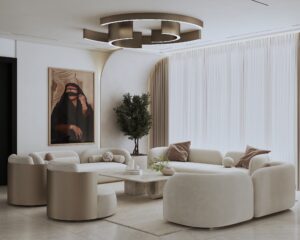
Why Living Room Design Matters More in Dubai
Dubai homes are unique. Between soaring ceilings, floor-to-ceiling windows, open-plan layouts, and a climate that keeps families indoors for much of the year, the living room carries more weight here than it might elsewhere. It needs to entertain, relax, and impress — often all at once.
This is why Dubai interior design has evolved into something distinct: a blend of contemporary minimalism, natural materials, and warm, tactile finishes that soften the city’s sleek architecture. Whether you’re furnishing a high-rise apartment or a sprawling villa, the principles of great living room design remain the same — thoughtful layout, quality materials, and a cohesive story that ties the whole room together.
Start With Layout: The Foundation of Every Great Living Room
Before choosing a single fabric swatch, we start with layout. A well-planned layout determines how a room feels to move through and how naturally conversation and daily life unfold within it.
A few principles we always apply:
- Anchor the seating around a focal point. This could be a statement piece of art, a media wall, or — increasingly popular in Dubai villas — a sculptural coffee table that draws the eye.
- Leave breathing room. Overcrowding a living room with furniture makes even a large space feel cramped. We recommend leaving at least 90cm of walking space around major seating pieces.
- Consider curved, modular seating. Rounded sofas and sectional pieces have become a signature of modern interior design because they soften sharp architectural lines and encourage face-to-face conversation, something traditional straight sofas often lack.
- Zone open-plan spaces. Many Dubai apartments and villas feature open living, dining, and kitchen areas. Using rugs, lighting, and furniture groupings helps define the living room as its own space without walls.
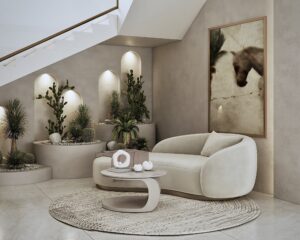
Choosing a Colour Palette That Feels Timeless
One of the most common questions we hear from clients is how to choose colours that won’t feel dated in a few years. Our answer is almost always the same: build your palette around warm neutrals, then layer in personality through texture and accents.
Neutral, earthy tones — think ivory, sand, taupe, and soft greige — form the backbone of most of our living room projects. These shades reflect natural light beautifully, which matters enormously in Dubai homes with expansive windows, and they create a calm, uncluttered feeling that suits both relaxation and entertaining.
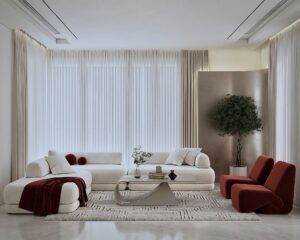
For clients who want more character, we introduce rich accent colours such as terracotta, rust, deep olive, or burgundy through cushions, throws, or a statement accent chair. This approach gives a living room personality without overwhelming the space, and it’s far easier to update seasonally than committing to a bold wall colour or an entire sofa in a saturated shade.
Metallic accents — brushed brass, warm bronze, or soft gold — are another hallmark of luxury interior design in the region. Used sparingly in lighting fixtures, side tables, or frame details, they add a sense of refinement without tipping into excess.
Furniture Choices That Define a Luxury Living Room
Furniture is where function meets identity. In our experience designing for UAE clients, a few pieces consistently elevate a living room from simply furnished to genuinely designed:
The Statement Sofa
A large, upholstered sectional or modular sofa in a soft, tactile fabric (bouclé and velvet are especially popular right now) instantly signals comfort and quality. Curved silhouettes are particularly well suited to open, airy Dubai floor plans.
A Sculptural Coffee Table
Marble, travertine, or curved plaster coffee tables have become a defining feature of contemporary living rooms. Beyond their practical use, they act almost as a piece of art at the centre of the room.
Accent Chairs With Character
A pair of bold accent chairs — in velvet, in a striking silhouette, or in a contrasting colour to the main sofa — brings energy and asymmetry to an otherwise neutral room.
Layered Lighting
Never rely on a single overhead light. The most successful living rooms we design combine ambient ceiling lighting, warm accent lighting (often built into arches or wall niches), and a floor or table lamp for softer evening moments.
Greenery and Organic Texture
Whether it’s a sculptural olive tree, a cluster of desert cacti in a styled nook, or a simple potted plant on the coffee table, greenery brings life into a space and softens hard architectural lines — something we incorporate into nearly every project.
Materials That Work With the UAE Climate
Material selection is one area where local expertise really matters. Fabrics and finishes that work beautifully in a cooler climate don’t always hold up to Dubai’s heat, humidity, and strong sunlight.
- Performance fabrics with UV resistance help prevent fading near large windows.
- Natural stone surfaces, such as marble or travertine, stay cool to the touch and bring a sense of quiet luxury to coffee tables and consoles.
- Sheer and layered curtains filter harsh daylight while still allowing rooms to feel bright and open — a detail we use in nearly every villa and apartment project.
- Breathable upholstery, such as linen blends, is a practical choice for year-round comfort indoors.
Architectural Details That Elevate the Space
Some of the most memorable living rooms we’ve designed owe their character to architectural detailing rather than furniture alone. A few details worth considering:
- Plaster archways framing a seating area or window, adding softness and a sense of intentional design.
- Sculptural ceiling features with integrated cove lighting, which draw the eye upward and add a sense of occasion to double-height spaces.
- Wall niches styled with plants, art, or decorative objects, which are especially effective in underused spaces like the area beneath a staircase.
- Gallery-style artwork, particularly large-format pieces that reflect regional culture and heritage, which anchor a room and give it a distinct sense of place.
These details are where interior design shifts from simply decorating a room to genuinely designing one — and it’s an area where working with an experienced studio makes a real difference.
Common Living Room Design Mistakes We Help Clients Avoid
Even with the best intentions, a few missteps come up again and again:
- Matching everything too closely. A living room where every piece is the exact same tone can feel flat. Contrast — even subtle contrast — brings a room to life.
- Ignoring scale. Furniture that’s too small for a large villa living room (or too large for a compact apartment) throws off the entire balance of the space.
- Underestimating lighting. Lighting design is often an afterthought, yet it has one of the biggest impacts on how a finished room actually feels.
- Overlooking flow. A beautiful sofa in the wrong spot can block natural movement through the room. Layout should always come before furniture selection.
- Choosing trends over comfort. Trends are a useful reference point, but a living room should be designed first around how your family actually lives day to day.
Working With a Dubai Interior Design Studio: What to Expect
If you’re considering professional support for your living room project, a good studio should offer more than furniture recommendations. At Sisterly Interior, our process typically includes:
- An initial consultation to understand your lifestyle, budget, and vision
- 3D visualisation so you can see the finished space before any work begins
- Sourcing of furniture, fabrics, and finishes suited to the UAE climate
- Full project management, from fit-out through to final styling and handover
This end-to-end approach is particularly valuable for villa owners and developers managing multiple spaces at once, where consistency of design language across rooms matters as much as the individual spaces themselves.
Final Thoughts: Designing a Living Room That Truly Feels Like You
A well-designed living room does more than look good in photographs — it shapes how a family spends its evenings, how guests are welcomed, and how a house begins to feel like home. Whether you’re working with warm neutrals and sculptural furniture, or bold accent colours and rich textures, the goal is always the same: a space that’s comfortable, considered, and unmistakably yours.
At Sisterly Interior, we bring together thoughtful layout planning, quality materials, and elegant detailing to create living rooms that reflect the way our clients actually live — whether that’s a Dubai apartment, a DIFC office lounge, or a family villa in Ras Al Khaimah.
Ready to reimagine your living room? Get in touch with Sisterly Interior today for a consultation, and let’s bring your vision to life with a design that’s tailored to your home, your lifestyle, and the UAE’s unique way of living.
Common Home Renovation Mistakes in Dubai
- Starting without permits — stop-work orders can halt your project for months. Always obtain DM permits and community NOCs before breaking ground on a home renovation.
- Choosing on price alone — the lowest quote almost never delivers the best outcome. In Dubai’s home renovation market, a contractor 30% cheaper than the average is usually cutting corners on materials, labour quality, or project management.
- Ignoring lead times — Italian tiles, German kitchens, and custom stone can take 12–20 weeks to arrive. Failing to order early pushes your entire home renovation Dubai timeline back.
- Underestimating contingency — concealed water damage, outdated MEP systems, and structural surprises are common in older Dubai buildings. Budget 10–15% contingency on every home renovation in Dubai.
- Skipping the make-good clause — tenants who renovate without reading their lease risk losing the entire security deposit plus facing legal claims for reinstatement costs.
- No phased plan for large projects — a monolithic renovation with no phasing strategy leaves you displaced and paying for a short-let for six months. A phased home renovation approach keeps you partially in residence.
- Choosing trendy over timeless — maximalist feature walls and ultra-specific colour palettes can date quickly. For resale or rental value, a home renovation Dubai should favour quality materials and flexible neutral palettes over viral TikTok trends.
Frequently Asked Questions — Home Renovation Dubai
FAQs
1. How much does living room interior design cost in Dubai? Costs vary widely depending on the scope of work — whether it’s styling an existing room or a full fit-out with custom joinery and new furniture. A consultation with a design studio like Sisterly Interior is the best way to get an accurate estimate based on your space and requirements.
2. What colours work best for a living room in a Dubai apartment or villa? Warm neutrals such as ivory, sand, and taupe are a reliable foundation, as they reflect natural light well and create a calm atmosphere. Accent colours like terracotta, rust, or olive can be layered in through cushions, throws, or an accent chair for added character.
3. How long does a living room design project usually take? A styling-only project can often be completed in a few weeks, while a full renovation involving fit-out and custom furniture typically takes several months, depending on the scale and complexity of the space.
4. Should I hire an interior designer for just my living room, or the whole home? Either is possible. Many clients start with the living room as the most-used space in the home, then extend the design language to other rooms over time for a cohesive result.
5. What furniture is trending in luxury living rooms in the UAE right now? Curved, modular sofas in bouclé or velvet, sculptural marble or travertine coffee tables, and layered ambient lighting are among the most requested elements in our current projects.
Ready to Start Your Home Renovation in Dubai?
Our team at Sisterly Interior handles every stage of your home renovation in Dubai — from concept and 3D visualisation to permits, fit-out management and final snagging. Contact us today for a free consultation and cost estimate.